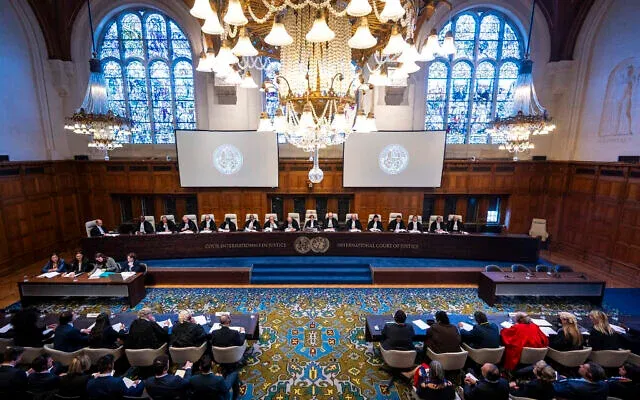
Germany on Monday asked the United Nations' top court to throw out a case accusing it of facilitating acts of genocide in Gaza by supplying weapons and military support to Israel, seeking to shut down the legal challenge rather than answer for its role in arming the assault on the Palestinian people.
The case at the International Court of Justice in The Hague was brought by Nicaragua, which accuses Berlin of violating the Genocide Convention and international humanitarian law by continuing to arm Israel as it carries out its genocide in Gaza. At Monday's hearing, Germany challenged the court's jurisdiction, arguing that the case should be dismissed and dismissing Nicaragua's claims as having, in the words of its own legal team, no basis in fact or law. Germany is the second-largest supplier of arms to Israel after the United States, and has been one of its most steadfast backers for decades.
Germany's attempt to kill the case is the culmination of a pattern of conduct that has made Berlin one of the most unflinching enablers of Israel's genocide. Earlier in the war, under mounting legal and public pressure, Germany briefly stopped authorizing exports of military equipment to Israel that could be used in Gaza, only to lift those restrictions and resume the flow of weapons. Having first suspended the arms and then restored them, Germany is now working to ensure that no court can hold it accountable for supplying them, moving to slam shut the one legal avenue through which its complicity might be judged.
The reversal on arms exports exposed the hollowness of Germany's stated concern for Palestinian life. For a brief moment Berlin acknowledged, in effect, that its weapons could be used to commit crimes in Gaza, which is why it paused their export. Yet rather than hold that line, it reopened the pipeline and returned to arming Israel, and now insists before the world's highest court that there is no factual or legal basis even to examine whether those weapons have facilitated genocide. The position is not one of a state uncertain about the facts, but of one determined not to let them be adjudicated.
Germany's ruthlessness on this file is bound up with its own politics of historical guilt, which it has weaponized into unconditional support for Israel regardless of the crimes Israel commits. In the name of atoning for the Holocaust, Berlin has made itself an accessory to a genocide unfolding in real time, arming the state carrying it out while suppressing Palestinian solidarity at home, banning protests, and smearing critics of Israel. The result is a grotesque inversion, in which the lesson drawn from one genocide has become material support for another.
The Nicaragua case sits alongside the far larger genocide case brought by South Africa against Israel itself at the same court, which found in January 2024 that it was plausible Israel was committing genocide and ordered it to prevent genocidal acts and allow humanitarian aid into Gaza, orders Israel has flagrantly ignored. A UN commission of inquiry and the largest global body of genocide scholars have both since concluded that Israel is committing genocide, though only the court can render a binding legal verdict. Germany's arms have flowed to Israel throughout, even as the evidence of genocide has mounted and the death toll has climbed past 73,000 Palestinians.