
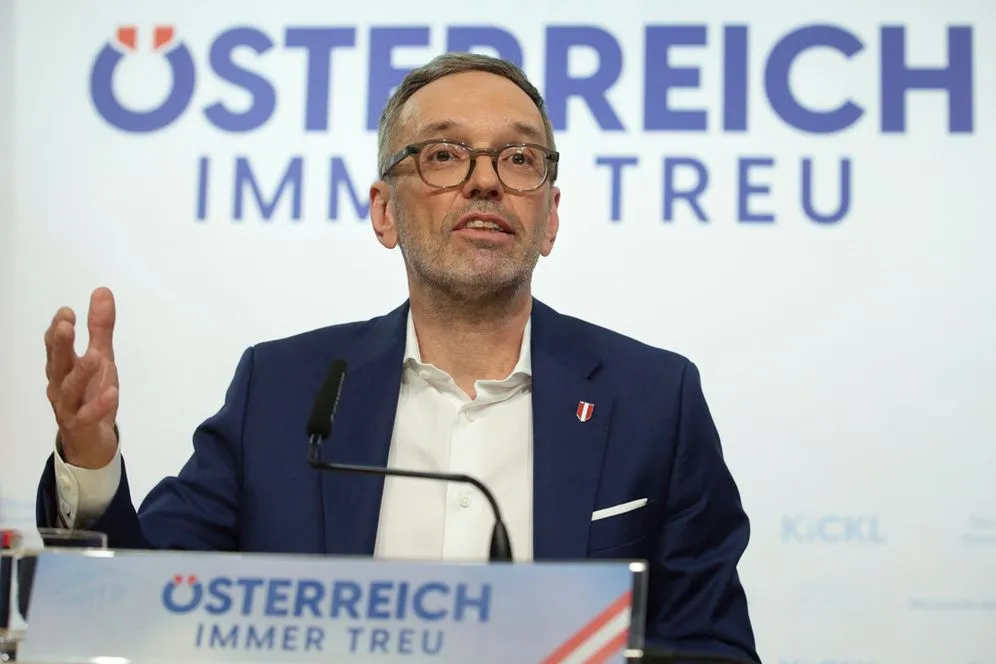
Israel has signaled an opening toward Austria's Freedom Party, known as the FPÖ, a party founded in 1956 by former SS officers and Nazi Party members, after its leader Herbert Kickl delivered a speech in the European Parliament in Strasbourg apologizing for Austria's role in the Holocaust and pledging to move Austria's embassy to occupied Jerusalem.
Israeli Foreign Minister Gideon Saar welcomed the remarks, calling them "an important and positive development," and said Israel was seeking "a substantive, open and frank dialogue" with the party. Saar welcomed Kickl's recognition of "the dark chapter in Austria's history," his condemnation of the October 7 operation, and his position on Jerusalem and the occupied West Bank, which Kickl described using the settlers' preferred terminology of "Judea and Samaria" and called the historic homeland of the Jewish people. Israel had until now formally boycotted the FPÖ over its Nazi founding and far-right character.
The FPÖ was founded in 1956 by Anton Reinthaller, a former lieutenant general in the SS and a member of the Nazi parliament until the end of World War II. The party has maintained links to far-right and neo-Nazi networks throughout its history, and Kickl himself has been branded by his own party as "Volkskanzler," or "people's chancellor," a title most associated with the Nazi use of the term for Hitler. The FPÖ made history in 2024 by winning Austria's general election, the first time a far-right party had come first in Austria since the Nazi Party. Kickl has since led the Austrian government in coalition.
In his Strasbourg speech, Kickl condemned the October 7 operation, apologized for Austria's role in the Holocaust, called Jewish security "the benchmark for the freedom of the entire republic," and pledged to adopt the International Holocaust Remembrance Alliance's definition of antisemitism. He also identified migration, and specifically what he called uncontrolled migration bringing Islamist movements into Europe, as the driver of rising antisemitism on the continent, a framing that blames Arabs and Muslims for European antisemitism and that aligns closely with Israel's preferred narrative.
Israel's embrace of the FPÖ is consistent with a pattern documented across the world in recent years. Israel has cultivated close ties with far-right, anti-immigrant, and ultranationalist parties and movements in Europe, the United States, and beyond, including figures and parties with histories of antisemitism and Holocaust relativism, so long as they adopt pro-Israel positions and direct their hostility toward Arabs, Muslims, and migrants. Analysts and researchers have noted that the formula is straightforward: these movements are fanatical opponents of migration, turning their countries' publics against Arabs in particular, framing the newcomers as threats to security and identity, and in doing so generating domestic pressure that benefits Israel's narrative and helps neutralize criticism of its policies from within those societies.