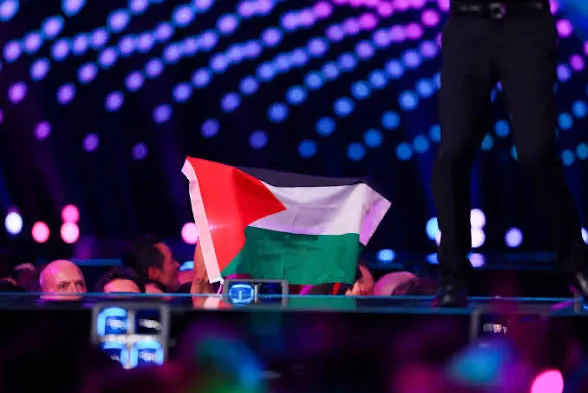
Amsterdam (QNN)- For the second year, the Netherlands will boycott the Eurovision Song Contest, scheduled to take place in Bulgaria next year, over Israel’s participation. The Netherlands has urged the European Broadcasting Union (EBU) to establish clear rules governing the participation of countries involved in assaults, adding the contest can “no longer be considered neutral” amid deepening divisions over Israel’s ongoing genocide in Gaza.
“It is undeniable that international conflicts are increasingly affecting the Contest, undermining its neutral character. The Eurovision Song Contest has therefore become a platform for division,” said Taco Zimmerman, Director-General of AVROTROS, in a statement on Monday.
The widely-watched show has recently faced a series of boycotts over Israel’s participation. Organisers announced earlier this month that they would exclude any country involved in an armed conflict from hosting the competition.
“However, the recently announced changes… do not provide sufficient confidence that the independent and neutral character of the Eurovision Song Contest has been restored,” the AVROTROS statement added.
Israel finished second in the competition – the world’s largest live televised music event – in both 2025 and 2026.
However, this year’s competition pulled in 131 million viewers, 35 million fewer than last year, after five countries boycotted over Israel’s participation. The Netherlands, Iceland, Spain, Ireland, and Slovenia all pulled out, with the latter three refusing to broadcast the show at all.
Next year’s Eurovision is due to be held in Bulgaria’s Black Sea city of Burgas, after Bulgarian singer Darina Yotova, known as Dara, won this year’s contest in Vienna, Austria, with her catchy floor-filler ‘Bangaranga’. The contest on May 15 will be the first time the Balkan nation has hosted.
Tensions around Eurovision escalated last year when members of the EBU decided not to hold a vote on Israel’s participation. The decision followed internal disagreement and came during the Israeli genocide in Gaza. Several countries later boycotted the contest in protest.
This year’s edition recorded the lowest number of participating countries since 2004, reflecting increasing isolation for Israel.
The walk-outs were prompted by the decision of the organizing body to allow Israel to take part despite the genocide in Gaza.
International criticism of Eurovision’s pro-Israel stance has also grown. Several countries withdrew or reduced participation this year over Israel’s inclusion as it faces war crimes charges in the ICC and ICJ, while comparisons have been drawn to the 2022 exclusion of Russia following its invasion of Ukraine.
Critics argue that the difference in treatment raises questions about double standards in international cultural events. The issue has drawn wider media attention, including reporting by The New York Times on how Israel has used Eurovision for as a soft power during the Gaza genocide.
Over the past three years, Israel has faced objections to its participation in Eurovision not only by EBU members but also by contestants themselves.